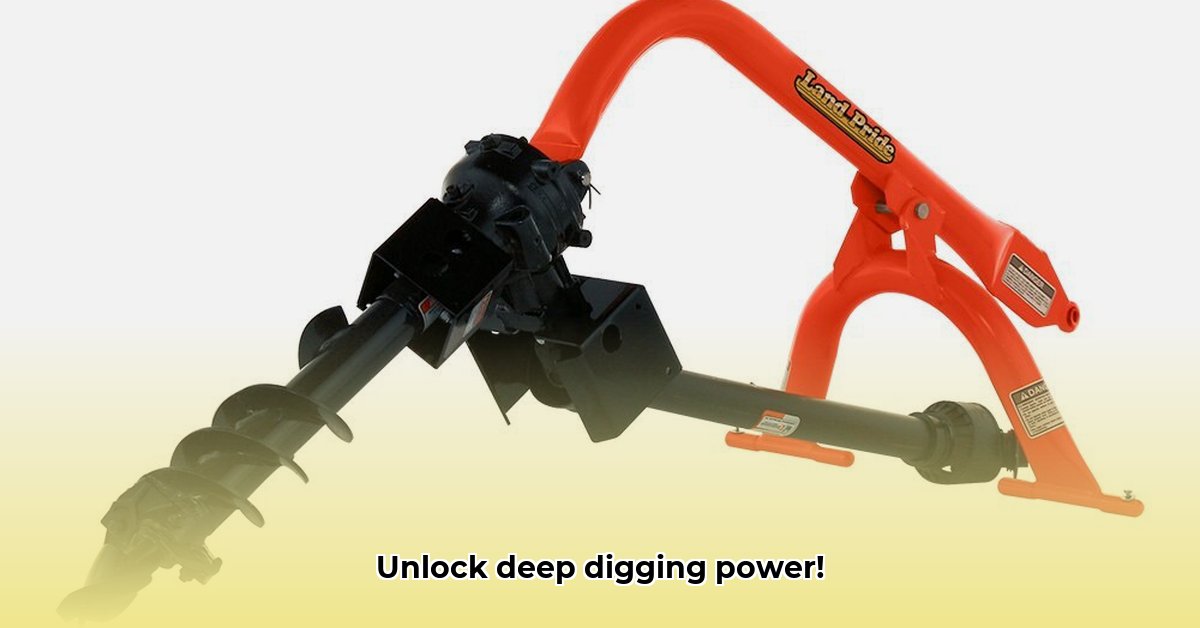
Subcompact tractors are increasingly popular for small-scale farming and landscaping, but finding the right attachments can be challenging. This review and instructional guide focuses on post hole diggers, comparing popular models and offering practical advice on selecting the right tool for your needs, particularly addressing the common issue of needing longer augers than are readily available. For more information on subcompact tractor post hole diggers, see this helpful resource: Subcompact Tractor Diggers.
Land Shark vs. Worksaver: A Comparative Analysis
Two leading contenders in the subcompact tractor post hole digger market are Land Shark and Worksaver Model 300. Both offer robust construction, but their features differ significantly. Choosing the right one depends on your specific needs and budget.
| Feature | Land Shark | Worksaver Model 300 |
|---|---|---|
| Auger Length | Variable; availability of longer augers can be limited | Fixed at 30 inches |
| Auger Diameter | Multiple options available | Multiple diameter options available |
| Build Quality | Robust and durable | Robust and durable construction |
| Ease of Use | Generally considered user-friendly | User-friendly operation |
| Customer Service | Generally receives positive feedback | Generally receives positive feedback |
| Price | Varies depending on auger length and diameter | Varies depending on auger diameter |
The Land Shark's advantage lies in its variable auger length options, although finding longer augers can be difficult. The Worksaver Model 300 offers reliable performance but is limited by its fixed 30-inch auger length. This limitation is a significant factor for users needing to dig deeper holes.
Choosing the Right Auger: Depth, Diameter, and Soil Type
Selecting the appropriate auger involves considering several crucial factors: hole depth, auger diameter, and soil type. These factors are interconnected and influence the overall success and efficiency of your project.
1. Determining Hole Depth: The required hole depth depends on the type of post and the local climate. Fencing typically requires shallower holes than planting trees, which require deeper holes to accommodate root systems and provide stability. For example, a 3-foot hole might suffice for a fence post, while a fruit tree might need a 4- or 5-foot hole.
2. Selecting Auger Diameter: The auger diameter should be appropriate for the post's diameter, providing sufficient space for insertion and firm soil compaction around the post. Too small an auger makes setting the posts unstable, while a diameter that's too large may not be feasible depending on the soil conditions and your tractor's capabilities.
3. Considering Soil Type: Soil type significantly impacts auger selection. Clay soil, for instance, presents more resistance than sandy soil. Clay soils may necessitate using smaller diameter augers or pre-wetting the area to reduce resistance and improve the auger's performance. Sandy soils, on the other hand, are generally easier to dig in, allowing for larger diameter augers. This needs to be carefully considered for choosing the right auger length and diameter for the project.
Decision Tree for Auger Selection:
                             Is the soil primarily clay?
                                    /             \
                                   Yes             No
                              /                       \
                         Smaller Diameter Auger      Assess Post Diameter
                         (e.g., 6-9 inches)          /       \
                                                    >4 inches   <=4 inches
                                                  /               \
                                      Larger Diameter Auger       Smaller Diameter Auger
                                       (e.g., 10-12 inches)     (e.g., 6-9 inches)
Compatibility and Installation: Ensuring a Secure Fit
Before purchasing any post hole digger, verify its compatibility with your subcompact tractor. Consult your tractor’s manual and the auger manufacturer's specifications to ensure compatibility with the PTO (Power Take-Off) shaft, hitch type, and the tractor's maximum lift capacity.
Installation Steps:
- Securely attach the auger to your tractor's 3-point hitch, following the manufacturer's instructions.
- Engage the PTO (Power Take-Off).
- Slowly lower the auger into the ground, maintaining a steady pace to avoid damage.
- Once the desired depth is reached, gently lift the auger.
Addressing the Auger Length Gap: Finding Longer Options
The limited availability of longer augers for subcompact tractors is a common challenge. Several solutions exist, each with its own trade-offs:
- Aftermarket Augers: Search online retailers specializing in agricultural equipment for extended-length augers compatible with your model.
- Auger Extensions: Check if manufacturers offer extensions that safely lengthen existing augers. Always verify compatibility.
- DIY Solutions (with caution): Welding extensions onto an auger is possible, but requires significant mechanical skill and attention to structural integrity and balance. Incorrectly modified augers can be dangerous. Consult a qualified welder or mechanic. Remember, safety should always be the priority.
Maintenance and Safety Precautions
Regular maintenance is crucial for ensuring the longevity and safe operation of your post hole digger. After each use, inspect the auger for wear and tear. Lubricate moving parts according to the manufacturer's recommendations. Always adhere to all safety guidelines.
Safety Precautions:
- PTO Shield: Always use the PTO shield to prevent accidental contact with moving parts.
- Stable Ground: Operate the tractor on level and stable ground.
- Clear Area: Maintain a clear area around the tractor.
- Protective Gear: Always wear safety glasses, gloves, and sturdy footwear.
- Never reach into the auger while it's running.
Conclusion
Choosing the right post hole digger for your subcompact tractor depends on your specific needs and project parameters. While readily available augers might be limited in length, creative solutions exist. Remember, safety is paramount, and proper maintenance is crucial for ensuring the longevity and safe operation of your equipment. By carefully considering the factors outlined in this guide, you can confidently select and operate a post hole digger that meets your specific needs, and safely complete your project.